How Writers Deal With Rejection

First of all, I changed the name of my file where I store my rejections, to “returned.” I know I’m only fooling myself, but I choose not to live as rejected. (Dejected, maybe, but not rejected…)

Second, I look the returned piece over (whether it is a poem, short story, or essay) and then do more research on where I might send it next. By this point I feel as confident as I will ever feel that it is good piece of writing, or I wouldn’t be sending it out. I have been writing and publishing long enough that I think I have a sense now of when something is good.

I don’t really spend that much time sending work out, because most of my writing time is spent actually writing. Or reading, or researching, or attending author events, or tweeting, or writing blog pieces. However, every couple of weeks I set aside a day, or a big chunk of a day, to do what I call a “blitz.” Wherein I do a major perusal of my unpublished work, and try to find a home for it by researching potential publications.

Many of my essays were published by the first places I sent them to, because I had developed relationships, over years of writing, with op/ed page editors. Or I had a regular gig as a columnist. Or I just hit the right chord with the right editor.

It’s hard not to give up on a piece that you love and have faith in, and I’m not sure how you know when to stick a fork in it. I have had several stories and essays that have been rejected (“returned”) after at least twenty or thirty tries. For real! I think you have to keep your faith in your work, or you just couldn’t do this for too many years.

If you want to read a humor piece that appeared in The Writer magazine (“Thoughts on Rejection in the Middle of the Night”) go to my posting on Jan. 17th, or go to the category “Writing” where you will find other essays I have published about writing and publishing.

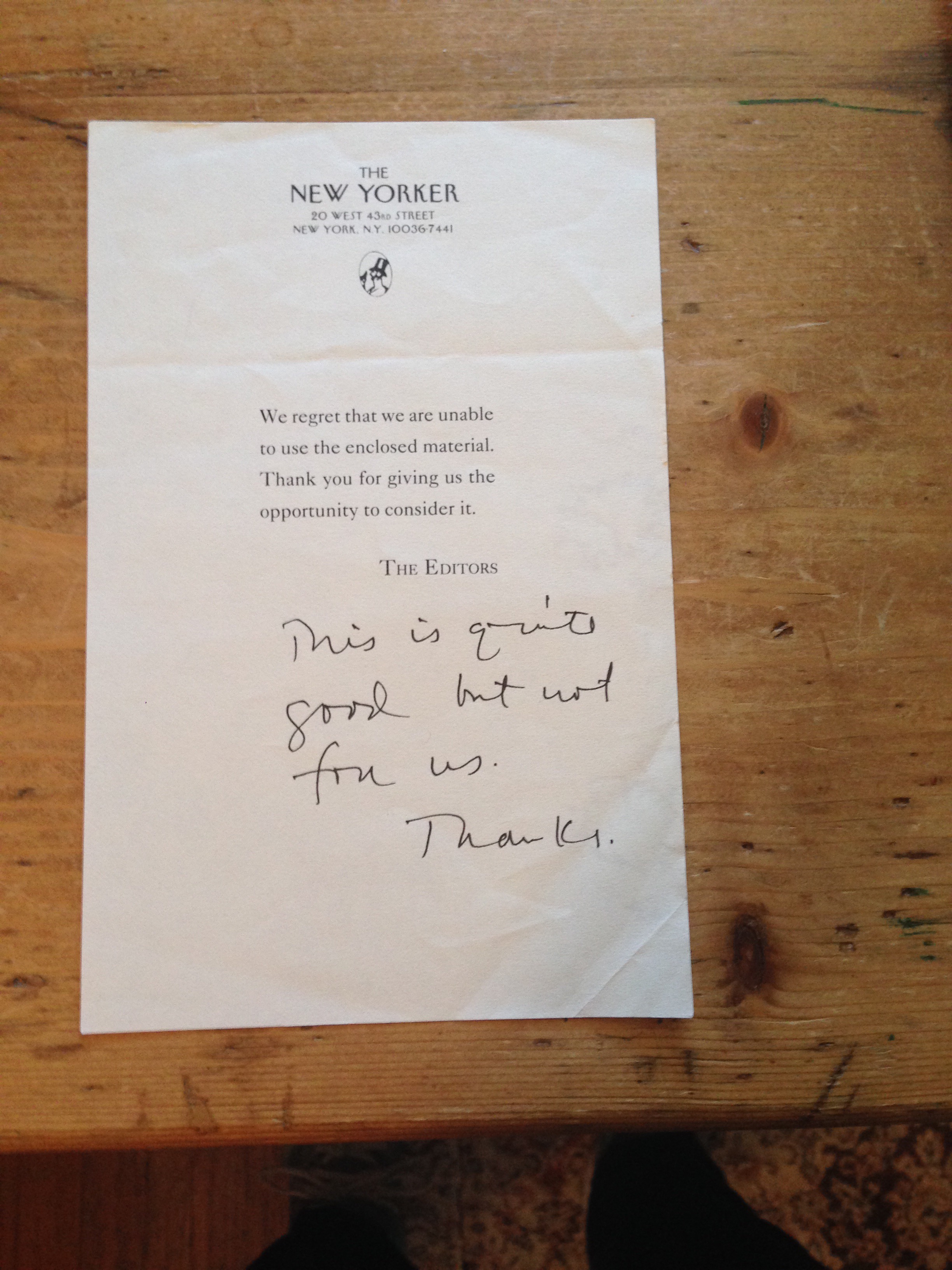
Here is a note I got years ago from an editor at The New Yorker (when I once had the nerve/guts to send them a short story). In writer pep talks, they always say that a handwritten personal note means something. I still haven’t figured out what…
Song Lyrics As Overlooked Poetry

When I was a 7th grade English teacher, and we had a Poetry unit, I had my students write down the lyrics to their favorite songs to share in class. Then we talked about the lyrics in terms of poetic sense, storytelling, word usage, and emotional resonance. 7th graders love music, but mostly they don’t think they will like poetry (they usually groaned when I announced the Poetry unit).

It was kind of hard not to sing the lyrics, but we made ourselves just speak the lyrics, and had some good laughs over the repetition and corniness of some songs. The whole class would usually burst into song at some point during several readings of the lyrics. It was really kind of fun.

I was reminded of this yesterday when I visited a special exhibit about the Rolling Stones at Navy Pier in Chicago. It was an amazing collection of their guitars, concert posters, photos, videos, clothing, and music. There was one section that had the REAL notebooks that were kept by various band members – notebooks where they wrote down their song lyrics. By hand, with pencils and pens.

Just like the rest of us writers (well, maybe not just like…) they started with an idea, or a feeling, and just started writing. They approach the creative process just like the rest of us non-famous writers. By putting one word after another, and trying to make their words sing.

In Praise of Nerd-dom

(A short essay in response to the Scripps Spelling Bee…)

I love seeing the faces of the finalists in the Scripps National Spelling Bee in news reports this morning. Bafflement, beady-eyed concentration, stunned cluelessness, and triumph are all written across the faces of these adolescent nerdy types. Released from being stuffed into lockers, being pelted with dodge balls, and being exiled to the bad lunch tables, this is their moment.

I actually find it amazing that spelling bees are still part of our culture. After all, computers have programs to check our spelling, and who spells anything out in e-mail or on Twitter? Like school bake sales, home economics, and white cotton P. E. uniforms, they seem an anachronism, a throwback to a more contemplative, cerebral, Mayberry-ish time. Continue reading

Lazy, Crazy Days of Summer

(This essay originally appeared in Main Line Life newspaper on 7/16/08.)
As I see children being shuttled to their summer day camps, swim and tennis lessons, and play-dates I wonder if at any point in their childhood they will be allowed to just run free. Gone are the days when you could assume your child would be safe roaming the neighborhood on foot or on bikes with other kids on your street. And when you live in an area that is as developed and urban as ours is, the opportunity to explore the outdoors is also limited. I doubt whether most kids today will ever know, as I did growing up, the wonders of the clay pits.

The clay pits was one of those places that today’s constantly monitored children would never be allowed near. When I think of all the ways we could have been accidentally maimed or killed playing there, I still shudder. Our parents either had no idea what a dangerous place it was, or they just believed strongly in Darwin’s theory – maybe a few of us needed to be weeded out. Continue reading