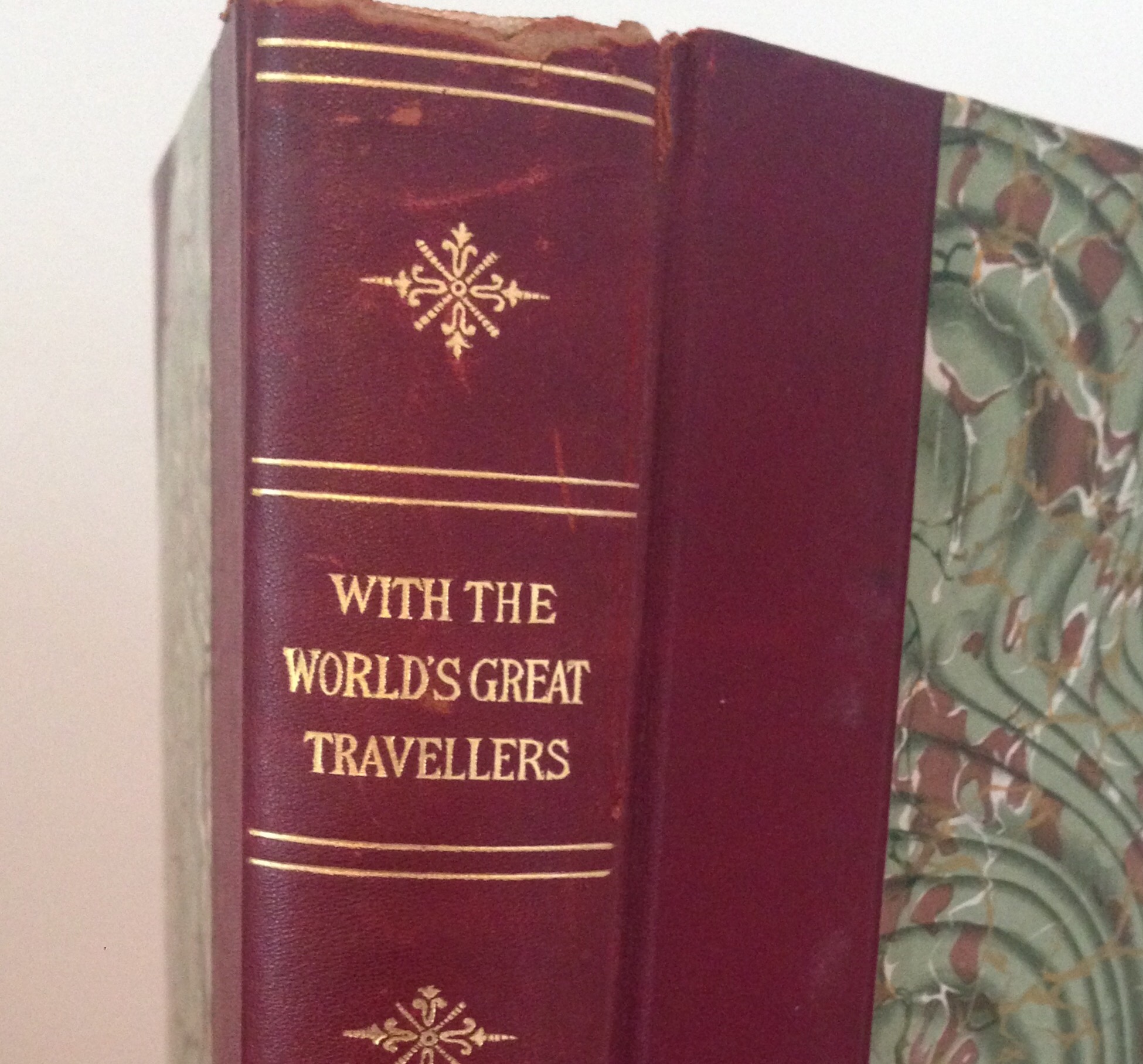
I found this amazing set of books at a swap meet several years ago: “With the World’s Great Travelers.” I think the set was about $40. The bindings are pretty shredded and the book covers are not in the best shape, but the inside pages are intact and very readable. I love browsing through them to get possible story ideas. There are a lot of first-person travel stories from a world that no longer exists. Case in point: The Pink and White Terraces of New Zealand, a onetime “Wonder of the World,” that was obliterated in a volcanic eruption in 1886. I used the descriptions of travelers who had seen this wonder, and wove it into a story of a young woman who might have traveled there. You can read my story in a separate post today.
The Pink and White Terraces of New Zealand
(This short story originally appeared in the South Boston Literary Gazette, and was awarded “best in issue.” Unfortunately, that literary journal was print only, not online, so I am sharing here online for the first time.)
THE PINK AND WHITE TERRACES OF NEW ZEALAND
Of the months at sea, the less said the better. Although the journey itself certainly must be mentioned. I set out from my adopted country a bride and returned a widow, a change of status I now think of as an improvement.
I was not altogether ignorant of a bride’s responsibilities and duties toward her husband. I had no mother myself, but in the convent there were young women my own age, and also maids and such who came in who talked a great deal more than you might think about the relations between men and women.
When I was a certain age, an acquaintance of a distant relative wrote to the sisters asking if I might be suitable for a match. I had not known of any relatives until then, and apparently they wished to remain anonymous, because I was never given their name or their whereabouts.
But that hardly seemed important, as the background credentials of Mr. Tucker were analyzed and it was deemed that I could do worse. I was sixteen and strong and healthy and couldn’t remain a ward much longer.
In exactly six weeks I was on my way to New Zealand. The year was 1885. Continue reading
Song Lyrics As Overlooked Poetry
When I was a 7th grade English teacher, and we had a Poetry unit, I had my students write down the lyrics to their favorite songs to share in class. Then we talked about the lyrics in terms of poetic sense, storytelling, word usage, and emotional resonance. 7th graders love music, but mostly they don’t think they will like poetry (they usually groaned when I announced the Poetry unit).
It was kind of hard not to sing the lyrics, but we made ourselves just speak the lyrics, and had some good laughs over the repetition and corniness of some songs. The whole class would usually burst into song at some point during several readings of the lyrics. It was really kind of fun.
I was reminded of this yesterday when I visited a special exhibit about the Rolling Stones at Navy Pier in Chicago. It was an amazing collection of their guitars, concert posters, photos, videos, clothing, and music. There was one section that had the REAL notebooks that were kept by various band members – notebooks where they wrote down their song lyrics. By hand, with pencils and pens.
Just like the rest of us writers (well, maybe not just like…) they started with an idea, or a feeling, and just started writing. They approach the creative process just like the rest of us non-famous writers. By putting one word after another, and trying to make their words sing.
In Praise of Nerd-dom
(A short essay in response to the Scripps Spelling Bee…)
I love seeing the faces of the finalists in the Scripps National Spelling Bee in news reports this morning. Bafflement, beady-eyed concentration, stunned cluelessness, and triumph are all written across the faces of these adolescent nerdy types. Released from being stuffed into lockers, being pelted with dodge balls, and being exiled to the bad lunch tables, this is their moment.
I actually find it amazing that spelling bees are still part of our culture. After all, computers have programs to check our spelling, and who spells anything out in e-mail or on Twitter? Like school bake sales, home economics, and white cotton P. E. uniforms, they seem an anachronism, a throwback to a more contemplative, cerebral, Mayberry-ish time. Continue reading

