 I was talking to a writer friend the other day about book signings. Mainly, what it is about a book in particular that makes the reader even want a writer’s signature on it. We buy tons of things every day that don’t require the maker’s signature. Maybe because a book, like a painting or an original photograph, is considered a work of art? Signatures of famous people in politics are often sought after, and those of athletes on sports memorabilia. But why writers?
When I self-published my novel The Lake Poet in 2001, it was a total DIY operation. I wrote it, edited it, decided on the fonts and the cover, got an ISBN number, wrote for permissions to use a few lines from poems, hired a printer, and it was off to the races. Since my book was a novel (historical fiction) about the town I was living in – Lake Forest, Illinois – I figured I at least had a good base of book-reading and book-buying enthusiasts who would want to read my book.
Also, Ragdale, a world-renowned artists’ community/retreat is located in Lake Forest, and they had kindly allowed me to write much of my book in a small space on their property.
It was off to the races. We have a really great independent bookstore in town, and they kept a steady supply of books. Ragdale hosted a reading and signing for me at the Deer Path Inn, and many friends who were book group members invited me to their book groups. I also marketed my books to local realtors; and the Lake Forest Historical Society, and the local library also made me part of a few community events.
In short, I found myself interacting with a huge swath of the local population. My very first “private reading” was at the beautiful artist studio of my friend Barbara Trentham, who has since passed away. I will never, ever forget the magic of that first reading in that magical space that Barbara had created for local artists.
Oh, one other thing. Neither Facebook or Twitter had even been invented yet. I thought I was pretty hot stuff because I had figured out how to sell my book on Amazon, and I had also set up a Google Blogger account for updates on my book and readings.
Of course I was the person selling my book, arranging signings, keeping track of finances (including payment of taxes as a local “vendor”), and still working on other writing projects. Granted, I didn’t have another job, so I was able to devote time to this that I might not otherwise have had the ability to do.
It may not sound like it, but this was actually fun! What could be better than toting your books around to people who actually wanted to read them? It was a writer’s dream come true. Again, it was because my book filled a niche in the community – a community of readers.
Believe it or not, I quickly sold out of the first printing of 2,000. And then a second printing of another 1,000. I did one last printing of another 1,000, and then decided that would be it. Unless I was able to find an agent to take the book on I was going to call it quits, and move on. I didn’t.
Looking back on that crazy DIY year, I remember how much fun it was, and how supported I felt by a reading community that wanted me to succeed. But the “literary event” that stands out the most, and that I will never, ever forget was when I did a book signing at the local supermarket during their annual Meat Sale.
Now, this was no ordinary Meat Sale. This was a yearly event that normally staid Lake Foresters beat the door down to get to. I didn’t get it, but this market had been selling my books at their cash registers, and I had been steadily replenishing their supplies every few days. (I know, who would have thought. Another note to DIY authors – you have to hustle and get creative in setting up your “distribution network.”)
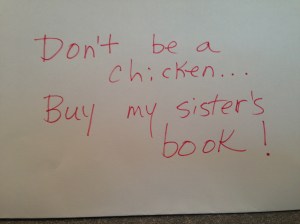
Back to the meat sale. The store owner had set me up at a rickety card table with a full view of the pandemonium at the meat counter. My sister had suggested I get in on the fun, and had sent me a few ideas for signage: “Don’t be a chicken. Buy my sister’s book!” was one memorable one (I did use it, and got some good laughs). Also, “Meat the Author.”
Customers seemed almost feral in their desire to get their prime steaks at a dollar off per pound. But, hey, what did I care? I was also selling books by the pound. I sold over a hundred that day, and well over a thousand at that grocery store alone over the year I kept it stocked there.
So, go local, if you think you have a supportive base to draw on. Use Facebook and Twitter and all the other great social media tools. Trust me, your readers are dying to “meat” you!

 kathystevenson.com